Monday, May 23, 2016

Essay #3 - My Trip to the Noguchi Museum


My trip to the Noguchi Museum brought back a lot of memories for me. Back in highschool, I had the opportunity to participate in their "Learning 2 Look" program, twice. We had classes and workshops back and forth between my school and the museum. At the end of the program, we got to present some finished art pieces to the public in a small gallery for a day. I took notice of the things that changed, and the things that did not. For example, during that time, it was unheard of for the Noguchi Museum to feature any artist's works other than Noguchi's. Now, though, the museum is featuring Tom Sachs' work. So needless to say, it was certainly an interesting experience for me coming back here.
Speaking of Tom Sachs; while roaming the multiple rooms of the museum, I came across this interesting piece:


This piece is called "Bonsai", and it was made by Tom Sachs in 2016. It was made by wielding together over 3,600 individual bronze casts, which I found to be pretty amazing. What I found even more amazing though was the items that were used for the casts... Those being common bathroom items. Q-tips, toilet paper rolls, toothbrushes, pipes, and even pregnancy tests!


I found it quite intriguing that the artist chose to use bathroom items for something such as a bonsai tree; in Japan, they're seen as things of beauty, worthy to display in the house for valued guests. Many even consider growing bonsai to be an art form. So to see this all come together into something that's still really beautiful, albeit in a different way, is really cool.
This sculpture is representational, as we can clearly see that it is a bonsai tree. However, all shapes (except for the square base) are organic. There are also a lot of lines, mostly made with the q-tips and rolls so as to represent the trunk and branches. Value can also be seen by the shadow the sculpture casts down onto the floor; in my opinion, it gives the sculpture a really neat look, as it gives the illusion that there is more positive space despite it actually being negative and just a shadow. It adds a lot of dimension to the piece.
The next piece that really caught my attention was actually this Barbie made by Tom Sachs, made in 2013: 


It's Untitled, but in parenthesis it says, "I loved my sister's barbie so very much. My parents, afraid that I'd turn out gay, encouraged carpentry. In secrecy I made my own. It wasn't love, only lust." I was really taken aback by that , and it really made me appreciate this piece all the more. I can actually really relate to that because, as a child, I was really interested in (stereo-typically) "male" hobbies, such as sports, comics and games. I wanted nothing to do with traditional girly or feminine things, such as dress up, pink, or boys. My parents heavily disapproved of that and tried to shove the latter down my throat, even as a kid, so I had to find means of doing what I liked in secret, and it felt really terrible. I can really understand how much sentimental value and meaning this barbie holds to the artist, and that's so powerful. I was really happy that I caught it.
This representational sculpture is made with plywood, hardwood, and vectran. There are a lot of lines seen in the wood, and also in her hair. The shapes are all organic. We can see a mix of cool and warm colors, as her body and lips are warm tones (brown, red) while her hair and eyes are cool (white, blue). While I didn't want to touch her with my hands so as to not damage her, I can definitely assume that the texture of this sculpture would feel more rough than smooth, perhaps with the exception of her hair. 
I think when it comes to comparing and contrasting these two sculptures, my first thought is that they're definitely more different than they are similar. Bonsai was made with a LOT of bronze casts, while the barbie was made with a few carved wooden pieces and fiber, and they're both vastly different in regards to subject matter. However, they actually have more in common than I initially thought. Both were assembled, as the Bonsai and barbie both had pieces that had to be put together, so that's something that they share. Additionally, they're both representational works. They're also both using materials that are not typically used to make what it is they're representing; Bonsai is representing a tree, but is using bathroom products to do so, and the barbie is representing a barbie, but is made with wood and not plastic. So they're meant to be representative of conventional images, but are made with unconventional material and means.


Tom Sachs actually really interests me as an artist. As a DIY lover myself who enjoys crafting and tinkering with things to see what I can make with them, I really appreciate Tom's DIY approach to his art work, such as with the barbie, or the lobster above (which I had a mini freak-out over because I thought it was the coolest thing ever). I think it's also really awesome that he uses a lot of re-purposed material and has this sort of anti-materialism message going on. The environment is something I'm really passionate about, so it's always awesome to see this sort of thing, especially in art. Also, he really loves outer space, and I thought all his work concerning it was really awesome too. I always love all things concerning the cosmos.
I think his work heavily contrasts Noguchi's in that a lot of Noguchi's work was more concerned with minimalism, and it seemed a lot more earthy. There's also more mystery with Noguchi's art, I think; you don't entirely know the meaning behind some of his work upon looking at it, while Tom's seemed a little more straightforward. I also felt a lot more calm around Noguchi's pieces, though I'm not really sure why. I think his pieces were just kind of "easier" to look at in that there weren't many shapes, lines, or details to take in. 
I honestly wish the museum was bigger so I could see more. I definitely plan on returning as not only was the art incredibly interesting, but the atmosphere of the museum itself was wonderful. I didn't feel overwhelmed by security, or worried that I was getting too close to a piece, or if it was getting a little too crowded; it felt so serene and it was truly a lovely viewing experience. The garden in particular was quite relaxing. I'm really glad I went!

Essay #3

I had incredible experience in Noguchi museum in last class. This place is not only museum, but also a experiencing new art world. First, I want to share about Isamu Noguchi before talking about his arts. I am very proud of him personally because he is the most challenger person I ever known. His father’s name is Yone Noguchi who came to the U.S. He met Reoni Gilmour and they were working together. In 1904 Reoni was birth Isamu Noguchi in the Looseness and they went to Japan to meet Yone Noguchi. However, they could not get back together and Reoni opened English Language School in Japan. After Isamu Noguchi grew up, he came to the U.S. by himself when he was 14 years old. He was studying in the Columbia University to become a doctor. However, he left his university and attended to an art school. He traveled many countries to learn different arts, cultures and styles. Finally he combine together with his own ideas to create a new art. In 1985 he opened his museum and he became one of the most famous artist, designer, and engineer.  Finally he passed away in 1988 at age 84. I believe that he truly loves art very much, has incredible talents of art, and was making so much effort to create each piece.


  I want to share two great works in this essay. First sculpture which name is “To intrude on natures ways”. Isam Noguchi made this couple years before pasting away. When I saw this work at the first time, I thought it is just a big rock but after looking it closely, it has a nice shape like a human body, and has specific 3 cuts like separating a face, upper body, and lower body. Moreover, it has different kind of colors by cutting and also has different textures. He wants to tell us that east culture and west cultures through this piece. The east culture is staying natural and the west culture is cutting and changing. After I heard details of this work, my eyes opened through this sculpture and it made me into this art more and more. Even though he used only one marble material of rock, he created many different shape, colors and textures in this work. That is why I am in love this sculpture.


   Second sculpture is “The well” which has very smooth movements by water. Moreover water was flowing equally even though it has rough texture because of 6 edges. Therefore, it shows that this rough texture is west culture and other side of smooth texture is east culture. I felt Japan through this work because many Japanese sculpture use water and people enjoy the water sound in Japan. I felt very relax and calm by watching this piece.

   I believe that Noguchi focused in “texture” the most because whenever I see his works, I want to tough, feel and experience them. Moreover, when I tough his works, I feel more close to the arts and drawn into his art world. That is why I love his arts and the Noguchi museum is my favorite museum I ever gone.

Essay #3

       The Noguchi Museum was founded and designed by a Japanese-American artist Isamu Noguchi (1904–1988). The museum display Noguchi life’s works and few Tom Sachs. Unlike other two Museums we visited in Manhattan, the Noguchi Museum has less visitors and it is very peaceful, that is very helpful when I concentrate and appreciation on their artworks.


       The class was divided into two groups, and I was in second groups. At the beginning,  the guide brought us to the second floor, and show us one of the Noguchi’s works which represent Noguchi himself. The exhibit has two parts. The first part is a stone with smooth surface, on the top of the stone has a fluting like a water channel all the way to the back. Under the stone is a triangle metal support. It's direct cut-in the bottom of the stone. This exhibit is very abstract, I don’t really understand it, but based on discussions between classmate and the Noguchi’s life that narrate by our guide. I guess the metal support represents the industrial age, and the entire exhibit represents Noguchi lived in two different worlds, Japan and America where, and suffering by straddle on two different cultures. After the discussions of this exhibit, we had a small activity. The guide took two baskets out, there are some wood bricks, stones, branches, shells, tin foil, etc. The activity is each of us pick up something from baskets, and put them together. The interest is when we just simply placed them together, they become something different, something like arts, or something pretty. I remember someone place a branch next to shell. That makes me to have an image of a ship dock on the beach.


       In the next, the guide brought us to see is Tom Sachs artwork which is about Japanese tea ceremony. The first of his work we saw is a unique tree which is made by bathroom supplies such as cotton swabs, toothbrush, center of toilet paper. Then we visited his tiny tea house. In Tom Sachs’ exhibit area, I felt a strong sense of the tea ceremony that being represented. Not just because exhibits make me feel that, and also layout in this area. The tea house, pool, tree, pavilion, and stone, all these exhibits in an area create illusion that here is   a garden where we can enjoy tea. Last part, the guide brought us to visit is Noguchi’s stone sculpture. 


      Addition, there is a stone sculpture, I had been looking at it for ten minutes. Its name is To Intrude on Nature’s Way, and it is basalt. When I saw it without read its name and note, I was wondering why Noguchi cut a nature stone into three piece, then put it back. After reading Noguchi’s note. I was kind of understanding his motive. As a Japanese-American, Noguchi is artistic style is between Eastern and Western. In Japanese culture, art of stone in a garden should not deviate from nature, but he also an American artist so he doesn’t want to hide his marks. I think the contradiction of this sculpture may also represent himself as a Japanese-American.


       The experience in the Noguchi museum was great. Although there are too many abstract works, Noguchi’s sculptures are show different style between Eastern and Western, Nature and manmade.


Zoma's Essay #3: Isamu Noguchi

The Noguchi museum is unique, in the sense that it displays permanently the work of one artist: Isamu Noguchi.  Tom Sachs another artist has been associated, but the museum was entirely dedicated to Noguchi. Noguchi was born from an American mother and a Japanese father. He can be considered as a self-made person, for having started at the age of fourteen to live by himself, far away from his parents. He may also be considered at a certain point as an improvised artist, for having started studies in medicine, and suddenly shifted to fulfill a career as an artist. The hybrid root of Noguchi, and also his trips in many countries have modeled his view of art. We will study two works of Noguchi, and also make comparison between them.
  
Noguchi’s work titled "To Intrude on Nature's Way" is a sculpture. It is half-carved from a piece of basalt. Many of the artist's work used the same technic. This concept stemmed from Noguchi’s hybrid roots Japanese and American. The uncarved part of the stone illustrates Japanese culture where the stone is in its natural form, symbolizing the attachment to pure nature. The carved part of the artwork represents the west civilization, characterized by its transformation of nature, its industrialization. However, if the artist is contrasting the two cultures, he does believe by representing them together in one piece that their mixing would be very productive. By this work, Noguchi also affirms his hybrid identify. The style of the work appears first to be non-representational. But the instructor has compared this work to another work of the artist, that was a stunning realistic sculptural portray made by the Artist. There were quite similitudes between both works, as they are both picturing a human body, a female body. Therefore, we would qualify the work as abstract, representing a female body in a very distorted way. We also learned something very important in the comparison, because we used to believe that artists who make abstract or non-representational woks had difficulties making representational works. So, we were very surprised that the artist with his ability of doing such realistic artwork abandoned this style in order to make non-representational and abstract artworks.  


"To Intrude on Nature's Way" as representing a female body, the sculpture was cut horizontally in three pieces as to show the three parts of the human body: the head, the thorax and the legs. The back of the sculpture is carved as to represent the back of the body. There is also a base would be the feet. The color is in the uncarved parts yellow, and black in the carved parts. The texture is rough. The positive space is the sculpture and its base included as part of the sculpture, and the negative space is the space around. We can interpret this by the view of the artist presenting the Eastern and the western cultures as center of a world gravitating around them, and emphasizing the necessity of unifying them to anticipate the future.
The second artwork is "The well". It is a variation of a Tsukubai that is a Japanese washbasin for purification. Like the previous artwork "To Intrude on Nature's Way", “The Well” is a sculpture carved in a piece of basalt. But in this work, the artist seems to have done a much finest work. Many parts are carved and there is stunning duality in the texture. Even though, we can see some rough areas in the piece, the whole thing looks very shiny due to the smooth falling water on the piece. This smooth, shiny and reflecting artwork gives the sensation of peace and tranquility to the observer. The artist was able to convey the idea of purity present in the Tsukubai that is a washbasin to purify those accessing a tea ceremony or holy places. Another aspect in the texture compare to the previous work can be seen in the symbol of roughness and the impurity of the human body in the previous work, in comparison to the smoothness and purity of the water that is used to clean the body and make it pure. 
In this work "The Well", Noguchi included a fourth dimension that is the movement and dynamism of the piece given by the falling water. It is also a sign of life. This artwork "has life". It is a “living artwork" and the viewer has this sensation. As also another major difference compare to previous work, Noguchi has chosen to place "The well" in the garden. Here, the symbol is tremendously great. The negative space of this artwork is the garden, as the natural surroundings of a river is the forest. In this work, the artist, also like the previous work, illustrates the duality between East and West. The roughness of the stone, and the purity of the water represent the East, whereas the shininess of the carved areas represent the West viewed as a transformer and a modeler.

In the general work of the artist, we see that the artist is a multiculturalist artist trying to conciliate eastern and western cultures which he comes from both, and views their reconciliation as a radiant horizon for the future. The artist also used non-representational and abstract art to convey his ideas, and he might see in this style of art the best way to express his basic ideas and sentiments, but also his deep feelings that himself barely apprehends. Noguchi is also a designer, engineer who through all his works, has broken the barriers and borders between those disciplines.

Essay #3


The class trip to Noguchi museum was a wonderful experience. When the professor said that we will be visiting the museum in Astoria I was surprised that there is any museum in my neighborhood. I live in Astoria for two years and I've never heard of Noguchi museum,pretty sad. I liked that the class was divided into two groups because we were able to experience and see everything without being crowded. I was in the second group and we started the museum tour from the second floor. We had a few minutes to observe everything and introduce ourselves to the tour lady. But mainly we were focused on one art piece by Noguchi.At very first look I didn't notice anything fascinating about the piece but when everyone started discussing further meaning of it I started thinking of the piece as well. The tour lady explained that Noguchi's mother was American and his father was originally from Japan. After Noguchi's birth his father left the United States and returned to Japan. This art piece represents the relationship between Noguchi's mother and father or may represent Noguchi as he is. The metal part of the sculpture represents Noguchi's mother (America was well known for production of stainless steel) and the stone, granite,on the top is from Japan. The metal triangle is supporting the stone. My group came to conclusion that there is circular energy flow around the sculpture. This additive sculpture may serve as a fountain.We see the presence of the stone and metal strong intersection. The sculpture is free standing and can be observed from any angle.
Another sculpture that I absolutly enjoyed looking at is located at the first floor.
The piece by Tom Sachs is comical and interesting mix media art work. He sarcastically named objects that can be found in a tool box,woman's purse and mini bar. Table salt he named "Satan",Tequila bottle as "Diablo",Chanel's bronzer as "Serpent of Old",Trojan Magnum condoms as "Beast" and screwdriver as "Lucifer". This relief sculpture is very unique and represents modern art.


Both sculptures, the Noguchi's and Tom Sachs', are reflecting their personality. The Noguchi's sculpture represents himself as combination of Japanese and American cultures.His temper and coldness from the sculpture reflecting the fact that his father never admitted Isamu Noguchi as his child. The tool box attached to the wall is reflecting Tom Sachs' humor or maybe his life. As an artist he probably uses most of these objects and the objects on the right side may be significant to his wife.
I definitley enjoyed the class trip to Noguchi museum as well as the park close to it.


Essay #3


The trip to the  Museum on Wednesday was a total different experience for Many of my classmates and myself. It was the first time that we actually went to a museum all together as a class, for many it was the time to socialize and make new friends, It was also a time to learn and explore abstract art. Related to the readings and what we learn in class, abstract art introduces us to unfamiliar situations, frees our brains from the dominance of reality and creates new emotional and cognitive associations. In abstract art, the brain is free to scan the whole surface of the painting rather than “fall” mostly into well recognized features.
        The Noguchi Museum was all base on the same artist and one form of art “sculpture” mostly abstract art. The history all around the Noguchi museum was fascinating, there was so much to learn about, each piece of art had a significant meaning to the artist and a history to reveal. The museum was kept the way the Noguchi wanted, everything was designate to an specific place, something that I love about sculptures is that everything is meant to see from different angles, In the Noguchi museum there was no line distance, even though we were not allow to touch the sculptures, there was extremely space to walk around them.
       Some of the history that I learn about Isamu  Noguchi was that he was born in Los Angeles, California in 1904, Noguchi  was a sculpture, designer, architect and a craftsman, he was all in “ONE”.  His mother  Leonie was an Irish American teacher and editor and his father Yone Noguchi was a  Japanese poet. At an early age  his father left them, eventually his mother went back to Japan speaking little Japanese and  with little resources to survive. At age 14, Noguchi comes back to the US with no parents, he started to write and edit poems in English for the first time, he was Studying to be a doctor at Columbia  University; But his dream was to became an artist, with the help of his mom he soon left the University to became on academic sculpture. Noguchi started working with figurative work, which then evolved to abstract art. In 1985 the Noguchi  Museum was open, and three years later in 1988 at age 84 Noguchi died.

      In all of Noguchi work of art we  can see a contrast  between Eastern and Western culture, it is the cultural divide between his parents, two distinct worlds and history that made him approach art in a unique way. Noguchi said “ The art of stone in a Japanese garden is that of placement. Its ideals do not deviate from that of  nature.. but I am also a sculpture of the West. I place my mark and do not hide.”  As a Eastern person, Noguchi wanted  everything as natural as possible, but as an western person Noguchi made cuts and designs. One of Noguchi free standing  sculpture  is “ To intrude on natures ways” . This sculpture is made from basalt, and it  represents abstract art, non-representational work of art. This piece is one, but also three, The shape of the art work is not define, but we are able to see a back and front side, there is Dynamic activity because the work changes as the spectator moves through space and time.The sculpture doesn’t follow a pattern, The sculpture is subtractive because the material was carved and molded to create the form and divide the sculpture into three parts   each with  specific cuts that creates some negative space in between the edges. As a Eastern person, Noguchi kept the natural colors of the stone, different colors, some of yellow, light/dark  brown and some gray. As a Western person Noguchi decided to make specific cuts in the stone. The texture of the sculpture is rough, but at the same time is smooth.We are also able to observed a square base and under a  wood base.
          Outside the museum in the garden, we are able to find another free standing sculpture “The well” made of stone ,which represents another abstract art. This sculpture is  also subtractive, because the material is carved to create shape. Dynamic Activity also plays on important role on this work of art because as I move through time/ space I’m able to see the changes of the work. We can also see some negative space in Noguchi signature in the lower level of the sculpture.  Value is extremely important because the sculpture has natural light, and as we get closer we are able to see our reflections in the water. The sculpture also has rough and smooth actual texture.  Thinking back to his life,  Noguchi couldn’t get more opposite with this sculpture. The sculpture has different kinds of geometric shapes there is a circle, square, pentagon and there  is also sharp and round edges. There is water that comes in, and water that comes out.  The sculpture is cover all with water and right next to it there is stone in the floor. Noguchi intentionally play with those opposites, on important part of his art was the material that he worked on and how that material represented him in a way.
 In both of Noguchi work of art “ To intrude on natures ways”  and “ The Well”  , we are able to see the contrast between western and Eastern culture. Even though the sculptures represented two different things, both represented him in a way. The fact that Noguchi came from two different backgrounds, strongly impacted his work of art.  In general I really liked his sculptures because they were really unique, and in order to understand them you really had to connect with his personal life. I admired the idea that he never rejected none of the cultures, instead he decided to join them and make unique  abstract art.


Essay #3

The Noguchi museum was a calming experience. Sculptures scattered throughout, aptly decorating their surroundings. It reminded me more of a gallery rather than a crowded museum. It was especially engaging, given that another artist was on display for the first time. The tea ceremony section in the center of the museum is Tom Sachs’ tribute, or response to Isamu Noguchi and his legacy; the visiting artist altered. In this piece, Sachs retains his carpenter, mixed media aesthetic and reinvigorates it with Japanese influences. I chose a piece from each artist.

The Noguchi sculpture I chose is a proposed design titled “Memorial to the Dead of Hiroshima.” It was designed and/or made between 1952-1982. The recreated model is made of Brazilian granite. The base is stainless steel and wood. The piece is subtractive, yet additive as well if you count the base. From my understanding, Noguchi was ordered to create this design as a proposal for a memorial. It was rejected and instead this smaller scaled sculpture was created years after. Although the design was made for a very specific purpose, you can still recognize many of the essential Noguchi trademarks. Such as the use of different materials – granite, steel, wood – the actual full-sized memorial might’ve contained more. However, I didn’t interpret the same emotionally driven use of different materials in this sculpture, as I did with other Noguchi’s. Consideration of how the sculpture affects the space it occupies is also evident. If the actual memorial was made, and assuming a person could walk through the negative space in the center, you can imagine a sense of weight and darkness would surround the viewer standing in the center. From a distance it feels as if the sculpture is in a constant state of expansion. The geometric lines carved on the surface of the sculpture reinforce this sense of outward movement, almost like a giant grenade ready to pop. I searched up the actual Hiroshima model and it’s definitely not as enticing as Noguchi’s. I plan to do more research on why exactly this design was rejected, if a reason even exists. The Tom Sachs piece I chose is more lighthearted, almost comical, and yet devilish. It’s a mixed-media sculpture. I couldn’t find any information about it online. It additively incorporates many miscellaneous objects found in an alcoholic-junkie-carpenter’s toolbox. Many of the items are engraved with words relating to ‘evil’ in one way or another. Though overwhelming at first, after a solid minute, I felt a sense of organized chaos being represented. Whereas Noguchi attempts to communicate a strong message with simplicity and elegance, Sachs seems to take the complete opposite approach. However, although this piece, seems congested with superfluous items, it should be noted that all the objects create a strong sense of harmony, very much like Noguchi’s, just in a different way. It seems almost unrealistic to imagine this sculpture, or any Sachs sculpture, with any of the objects missing.


Each of Noguchi’s sculptures produces an isolated story and emotional message with ease and grace. The environment felt serene and perfectly in sync. I regret not taking more time to walk around each sculpture, to fully take in the perspective and message. The wide-open space allows your thoughts to roam unrestrained. The lack of labels and descriptions added a unity between the sculptures. It also produced a sense of mystery, and I feel a strong need to return and learn more about each individual piece and its place in Noguchi’s timeline. Tom Sachs added an inviting dynamic between simplicity and complexity. In the future, I hope more contemporary sculptors host their work at the Noguchi museum. Seeing one artist directly respond to another was something I had not previously experienced.

Essay #3

                Visiting Noguchi Museum was awesome. It wasn’t an ordinary museum that I thought of. Most museums that I went in New York was crowded, filled with many exhibitions of other artists, with strong system of security. In this museum, we were able to look at Noguchi’s work as close as we want and feel the atmosphere (negative space) around the sculpture of his work. Most of the Noguchi’s work was a sculpture and it was based on an abstract art. As I walked around the museum, I like the way how museum only had the exhibitions of his work and few works of Tom Sachs who is related to Noguchi. That way, I was able to focus on Noguchi’s values of art.
                In the beginning of tour in the museum, the tour guide began talking about Noguchi's parents to describe the background of Noguchi. Noguchi is an artist who is half American and half Japanese. He went to Japan with his mother to find his father but Noguchi was rejected by his father that he is his son. The interesting part is that, even though he was rejected by his father who is a Japanese men, Noguchi didn’t deny the fact that part of his gene is from Japan. In his sculptures, you can find the combination of eastern and western which is based on his identity.


 First work that I saw in the museum was Two Intrude on Nature’s Way. It was his late work made by basalt material. It is heavy and dense. This sculpture have two opposites. One part is almost flat and the behind of the sculpture is caved in. What was interesting about this sculpture is that it is divided into 3 sections and when you compare it with his first figurative abstractive work, you can actually see the similarity from the outline. This sculpture also shows the combination of Eastern and Western feature. One part of the stone is shows a natural looking stone which isn’t carved at all. This shows the Eastern practice of leaving the natural things as it is and the Western practice of carving whatever it is and making it into some different form. This way, the part where it’s not touched is has a rough texture and the part where it is carved have a smooth texture.


                At the outdoor of the museum, we looked at a sculpture called well. It is a well that water flows from the top to bottom. This sculpture also had a two different side. It had very smooth texture and on the other hand, it also had rough texture of the stone. It had parts where it’s not touched and also where it was carved artificially. Noguchi carved the stone and put the initial of his name. On the top of this sculpture, there was symmetrical shapes of square which have a sharp edges and a circle that is round. What was interesting about this sculpture is that it had a movement of water and it is pumped up inside the sculpture and we can see the water flowing down outside from the sculpture.


 Noguchi has went to lots of trips around the world. He made the sculpture as he went to the trips. Some pieces are combined from other place with the pieces in the United States. One of his work for example is Fudo. Fudo means guardian of Buddha. This sculpture is made with a stone from Japan and he carved it. Then he took the stone to the United States and put the metal as a base which integrates the two.


Sunday, May 22, 2016

East meets West

"I feel a home everywhere, I feel like home nowhere." said Isamu Noguchi. Most of us have an idea of where we came from and where we belong. However, to Isamu Noguchi that's a difficult situation. Noguchi was born in United States. His father was Japanese and mother was American. Therefore, he was stuck between Japanese and American culture. He went to school in America, but unlike all of us, it was hard for him to make friends. It wasn't because he doesn't like to talk or being unfriendly, the main reason was he's different from others and that only difference was his Japanese culture. Then, Noguchi decided to change his name to Sam instead of Isamu, so he could fit in. I understood Noguchi, because I was once feeling different from everyone else. It was when I first moved to America, I went to school in Indiana. All the kids would look at me differently and it was difficult for me to make friends. At least I was lucky enough to have an English name. On the other hand, when Noguchi visited Japan, he was seen as an outsider. During that period of time, you will be consider as an outsider if you're not 100 percent Japanese. However, being multicultural isn't always a bad thing. It allows you to open your eyes to the world and you'll become more curious with what else is out there that you never met. The more you see, the less you know. This is where Noguchi found his place in art and his form of style. Like most people mentioned, Noguchi's art is a combination of East meet West. His arts are mixture of western and traditional Japanese style.


I am glad to be able to visit Noguchi's museum located in Queens, New York. Throughout the tour of his museum, I was able to see how he interpreted his understanding in both Eastern and Western couture into his arts. Before I start speaking about my experience with Noguchi's art works, I must start with the architecture of his museum. When you first see the museum, you would probably think that it's just another public school. However, once you enter the museum, you'll get the feeling of zen and peacefulness. The interior of the museum is very spacious with high ceilings. Ever though the rooms were spacious, the position of his art works between one and another was very close. It created an unity between his art works. It was almost like Noguchi's art works were communicating with each other. In my point of view, the museum became an art work itself. Noguchi also incorporated his traditional Japanese culture into his American museum. Everything in his museum looked very modern and western. However, there was also an outdoor part to the museum. The outdoor section looked like a traditional Japanese garden. It was very relaxing to walk by. This is where the first sculpture that caught my eye located. It was a well made out of stone. What made this well different was that it has unlimited overflowed water. The water would come from the center of the well, then flow along the side of the sculpture endlessly. The design of this sculpture was also very special. Traditional Japanese well are usually in a perfect round or cube shape. Noguchi's sculpture was in an undefined shape with a perfect circle in the center where the water would flow out. On the surface of this sculpture, you will be able to find flat and smooth texture, as well as rocky and natural texture. However, the overflowing water touches every part on this sculpture. This is a great example of how he combine western and eastern culture into his art works. Another art piece that caught my attention was his Akari light, also known as paper lantern. It was a foldable lantern made out of paper and metal. My first thought was nothing special, I could probably but it from Ikea. Then, after knowing that Noguchi is the one who invented this shocked me. I would never thought an artist would be able to create an art and this art could become an invention that impact the world till this day. Noguchi first seen the Akari lantern at the Gifu festival in Japan. He thought the lantern were amazing and he wanted more people to be able to see it. However, during that period of time, Akari lanterns were heavy and big. Then Noguchi had the idea to create the same Akari lantern, but the lantern is foldable so it would be easy to place it in a box size of a pizza box. All of Noguchi's Akari lights are hand made. They might seem flat and tiny when you take it out the box, but when you unfold the light, they are tall and luminous. After learning that something I had been using throughout my life was made from an artist instead of an engineer excites me. It made me start wondering what else could be possibly invented by someone unexpected.


The visit to the Noguchi museum was great. I enjoyed every art work in there and these are the two out of many that caught my attention. In addition, I enjoyed more than just the visit. I was also fascinated by Noguchi's life story. Being able to understand his hardship when he was a child, helped me understand his art work even better.    


Friday, May 20, 2016

NOGUCHI MUSEUM


Who would know that after years of dwelling in Astoria I could’ve missed a hidden gem: Noguchi Museum and its beautiful Zen Garden. Isamu Noguchi, a Japanese-American artist turned it into a very private, almost exclusive spot, where one can enter his secret sanctuary through a very small entrance. Our soft-spoken romantic guide Simone told us he was raised by mother, a writer, and father, a poet. However, his father never accepted him as his biological son so therefore Isamu ended up creating his own physical space in attempt to escape his sadness and questions he could not find answers to. He actually first bought a gas station, then started creating a garden, before everything transformed into an amazing museum where one can find his or her peace. Born in the beginning of 20th Century, Isamu’s career spanned over amazing six decades.

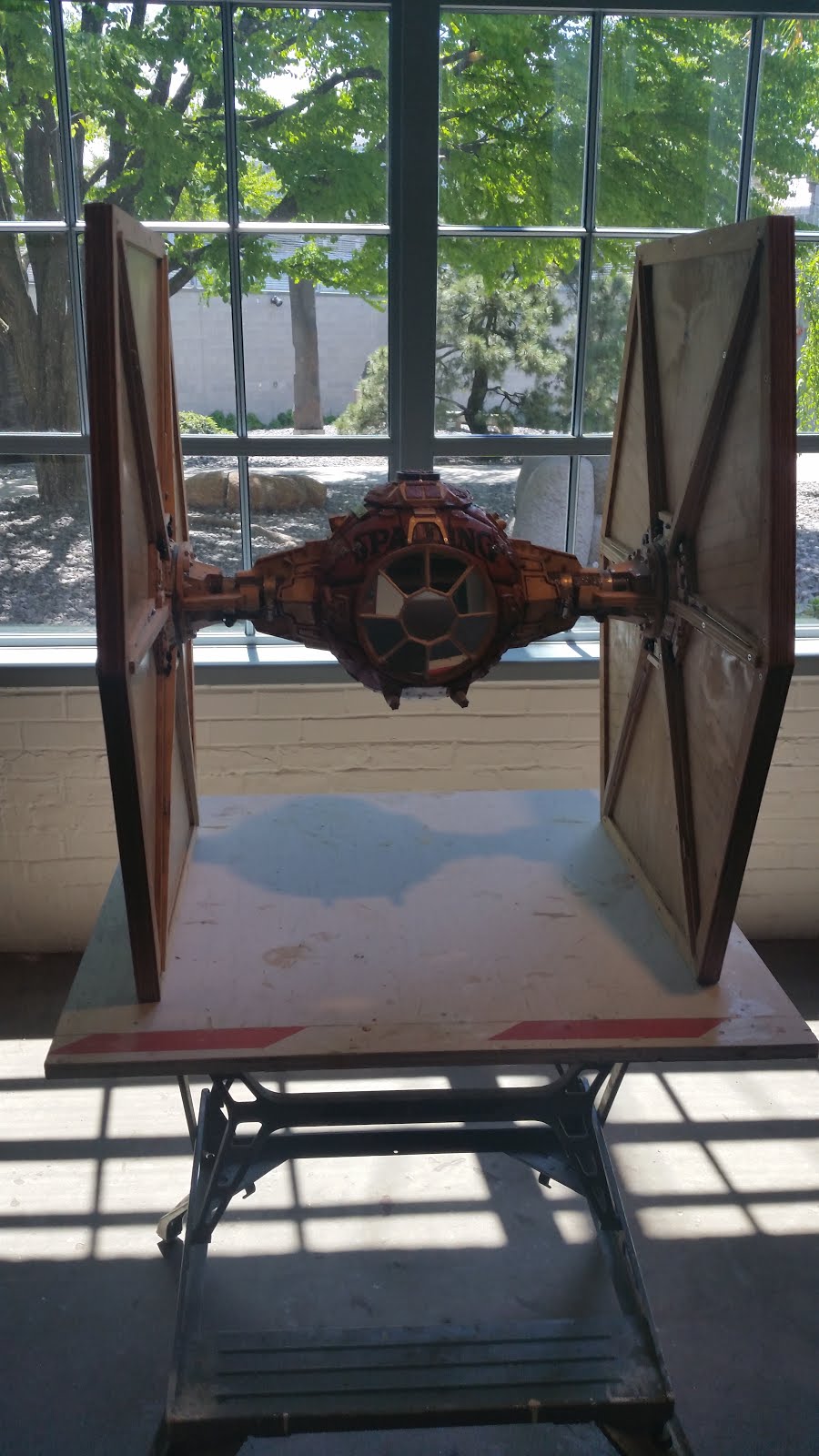
Noguchi loved sculptures and he used all kinds of materials: stone, metal, steel, marble to name a few. Furthermore, his creative art includes representative assemblage of items in attempt to capture the essence of time in many periods of early and mid 20th Century; for example, a typical closet of an average american family in 1960s or a replica of spaceship from the movie Star Wars which symbolized the 1980s. Before we continue walking through his museum let’s mention his “outside” work like a beautiful stainless steel statue (relief) named “News” on a luxury building at Rockefeller Center in Manhattan. 

At the museum Noguchi predominantly used stone, steel, and black marble. In one of his first sculptures he used a pairing technique of stainless steel with stone (actually, a granite) where he wanted to describe the connection between a granite, earthy material of nature representing warmth, strength and security which many believe represents his mom he loved while steel represents the cold product of those ugly factories which were always far from people, just like his father who was absent in his life. This creation encompasses these thoughts, the hollow triangle-shaped-steel cutting through while supporting a rounded granite with water channels carved in. It can be explained how his emotions and energy were able to flow unrestrictedly, but with very different colors of his emotions: the granite represented warm feelings that would shift into cold ones once he thought about his father, who represented the steel. Nevertheless, he always felt free.

Museum’s each room has different art, but art in each room follows certain pattern accordingly. For instance, the top room with roof and moonlight/skylight windows (what a great surprise) had stone sculptures and fusions of stone and metal. It was a space to relax, to think, to reflect on oneself etc. Another room had a beautiful casted tree welded of tins, cue pics, toothbrushes, some spiky things, and “maybe a toilet paper holder as well” as our professor added. The pattern was followed by a tall lantern and a well-like wash basin, where he used predominantly metal, and colors of gold and black. The tree itself had a strong pattern of items used by all people for personal hygiene. More generally, they are all used for cleaning. What’s the meaning of tree that can grow and live for hundreds of years and cleaning? Maybe Noguchi tried to tell us even if it takes a lifetime to never give up on ourselves? If so, great message.

Noguchi’s art shows that the object is not just physical, but how that object changes space around it; us within. 

My class was really lucky to come at odd time when Noguchi museum allowed another artist, Tom Sachs, to present his art named so cutely: A Tea Ceremony. Sachs’ art blended in perfectly with Isamu’s visions. Sachs recreated all steps when one makes a tea through his art and we were told there were live performances as well. The idea is to get a relaxation through simplicity just like one would when gardening for instance, or any hobby that involves raw and better connection with Earth.

Finally, the garden(!). Even though the green trees and blended colors didn’t reveal it at first it became obvious that the light-grey path divided the garden in two sections: the one with brown ground and red rocks, and the other with white stones and pebbles. What a great way to use negative space. Both areas displayed the sculptures following similar patterns. First I walked toward an upright free-standing sculpture called Core. It was made of basalt (a fine-grained, dark-colored volcano rock) in 1978. It resembled a rectangle but still looked abstract. It was hollow, with two circular openings facing each other on two sides. It looked serious, even on that beautiful sunny day.

When I sat on one sculpture (before they removed me of course) I finally noticed the free-standing well. Actually, it was a fountain-like with water running quietly, pouring from the opening in the middle,  and then disemboguing while covering all the surfaces of this hexagonal-like well. This representational art was magnificent. It was also made from basalt, in 1982. It was so smooth. But this was a tallish well, as opposed to ones that sometimes are leveled with soil. Once I leaned over I could’ve seen that inside was a tunnel-like space connecting to levels, or what was seen in most of Noguchi’s art, the channels. This is obviously his way of giving a freedom to water so it can float liberated from any constraints. Both sculptures were neutral dark as if the artist didn’t want to influence our feelings just yet, but to focus on forms and shapes, and to navigate us toward the bigger realization. 

Once at home when I observed my photos I became more aware of light and shade and I realized the crescent shapes in those two circles of the Core sculpture and one crescent-shape within the well formed by the Sun falling upon them. I also became aware of the VOID in these hollow sculptures. Then I had my silver lining when the crescent shapes connected with my Kabbalah readings (long ago though) and translated into this Zen garden where I realized the garden is meant to be observed at night during the moonlight under a clear sky that falls upon the sculptures and creates those crescents. A small pattern of the museum is even an astronaut placed by the stairs that symbolizes the moon and night (astronauts can walk on the moon only at night; impossible during the day). Zen garden “idea” comes from Japan but is used for meditation and in Buddhism as well. Noguchi’s vision is not just simple relaxation but to achieve a nirvana, and not just thinking but to let ourselves exercising our thoughts on a much higher level. What about the water of the well that gently caressed it? It looked like a basin where we can wash our hands and face (another cleaning tip) before we can start our prayer, meditation, our soul cleansing. And when best if not making a connection with the light of our creator that can be felt at night in complete silence. What a beautiful answer when one seeks to fill the void. Thank you Isamu.

Thursday, May 19, 2016

Noguchi Visit: A Japanese experience


   I had the great opportunity to visit the Noguchi Museum. This Japanese place isn’t like other one I have visited before; the reasons are the following: is based in only one artist (its founder Isamu Noguchi). Doesn’t have that overwhelming security that other museums have, hence you can walk around each sculpture and get really close (without touching them of course). Is not crowed, so a sense of peace surrounds it (like you can feel the “Zeng”), and is really captivating. 

   From all the awesome sculptures I observed I will talk about two (2):

1.    Slide Mantra (1966-1985) made of Botticino Marble.

2.    The Well (Variation on a Tsukubai) (1982) made of Basalt.

   No because are better than the others, but because somehow I feel more identify or attracted to those ones.
Mantra Slide
I will begin with Slide Mantra, this modeled 3D form which is basically a spiral stair with a slide at the end reminds me of my childhood times, those fun and innocent times when I used to play with no worries. Also reminds me of the Google Company, because they have this kind of stuff for their employees to make their work place funnier (https://officesnapshots.com/2012/09/06/inspiration-offices-with-slides). This sculpture automatically triggered those flashbacks. 

   This art is representative (stairs, slide), but in my opinion (which is subjective) not only has a physical representation, but a psychological/emotional one too, as I stated before regarding my memories and fun. 

   This sculpture has a really smooth surface (as a good slide must), and its measure v
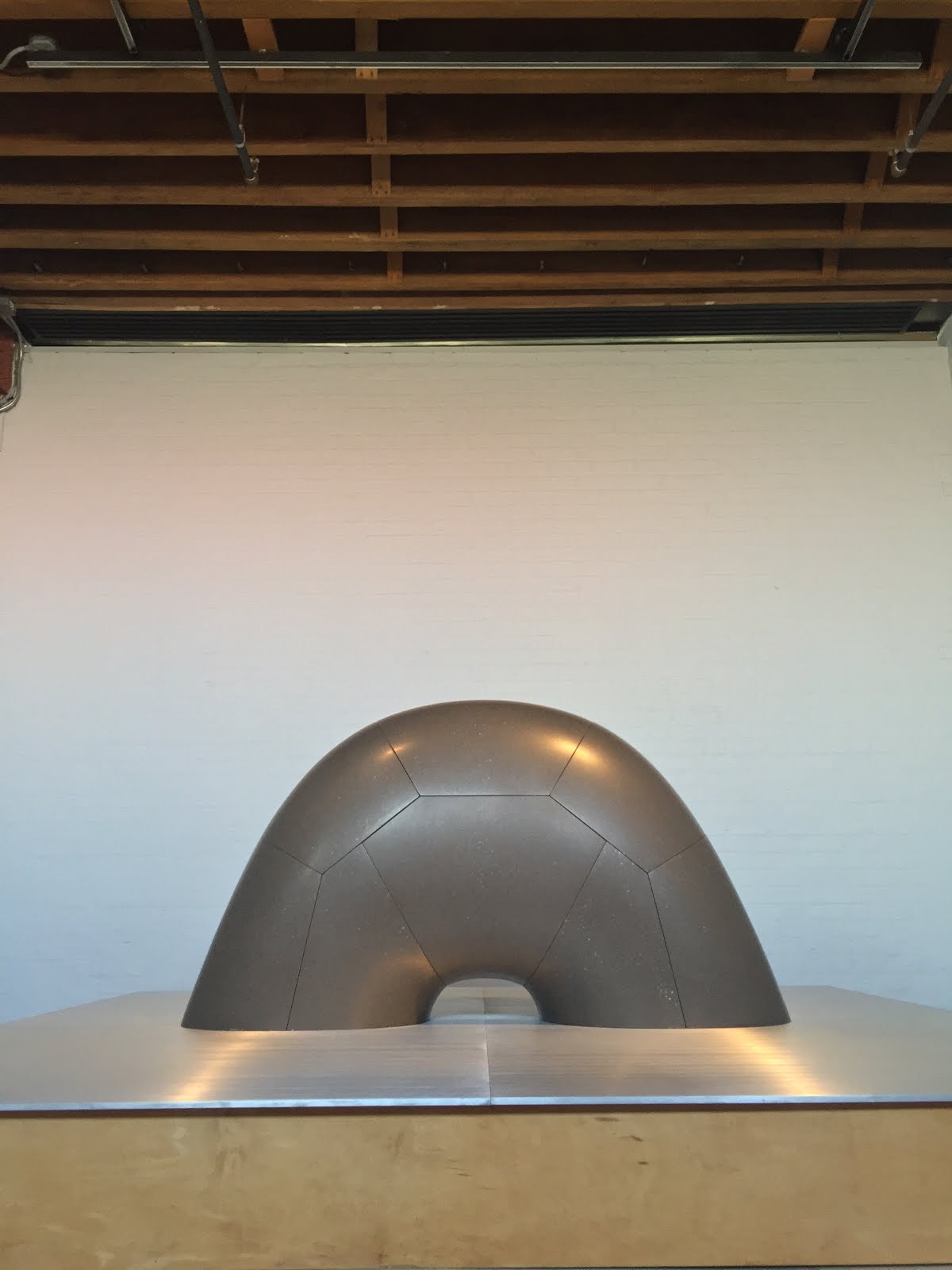
aries according the place is installed. The one observed at the museum is a small scale model of the big ones installed around the world. Some playgrounds have real slides with this design. Since it has a spiral shape, it posses negative space (as you can see in the photo).


   The Well, is

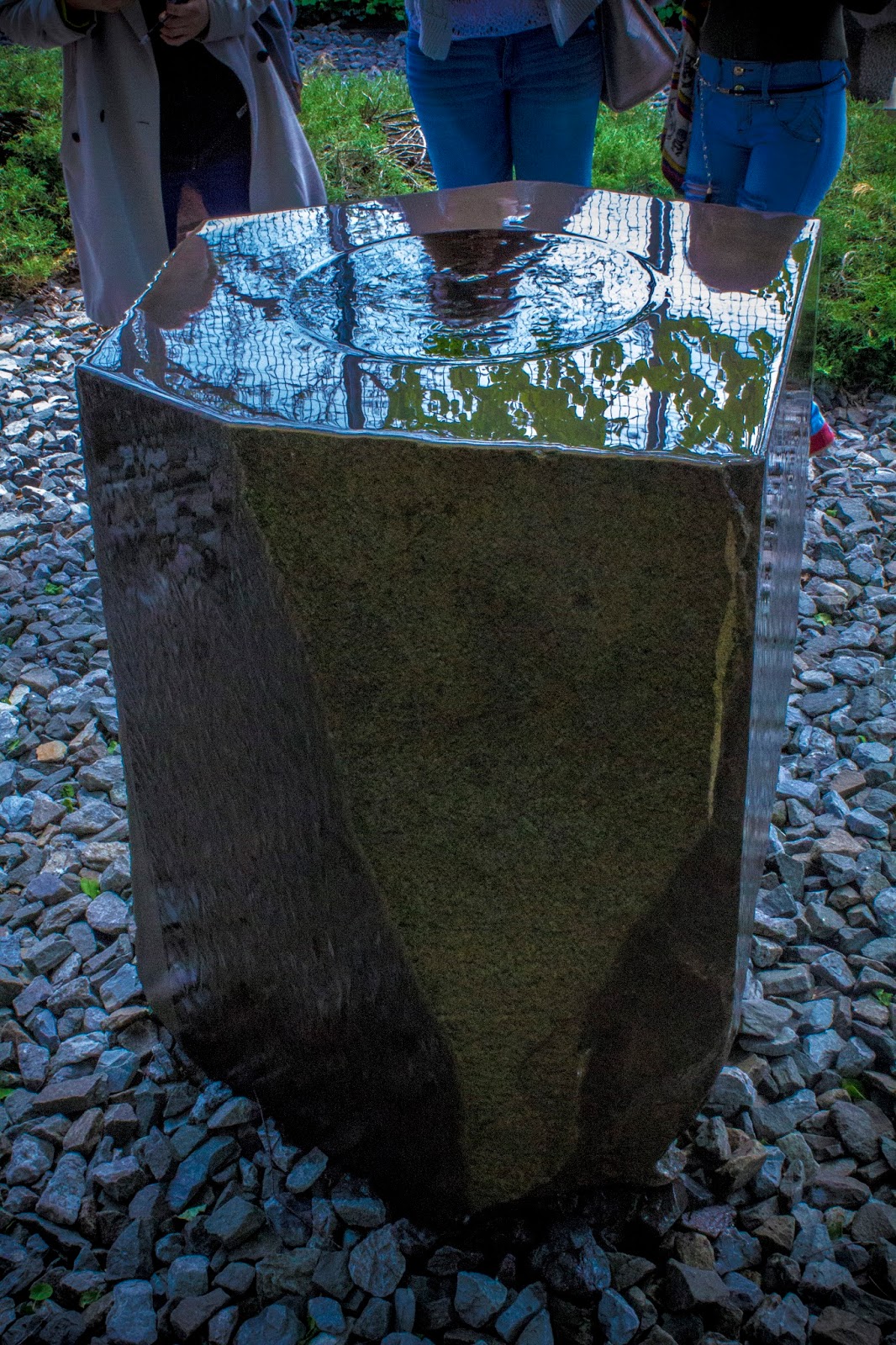
an abstract sculpture with hexagonal shape that have been carved and has two different alternated textures (smooth and rough). The middle has a bowl-like indentation perfectly shaped which is a fountain, but the water that comes from it, comes in a peaceful way, really smooth, without splashing around. It flows slowly covering the sculpture. I really love the surface, the wet smooth surface plus the water make it look like a mirror, reflecting all around, but also make it looks like a mystic fountain, like in the fairy tales when you can find secrets inside it.

   Although this art is abstract it has a meaning behind. From what I learned in the tour Noguchi had double nationality, he was American-Japanese. Many of his sculptures are made this way, with two different surface, two different elements, etc. but let’s focus on this one.

The Well
   Two different surfaces, rough and smooth, representing his double nationality, but if I have to guess which surface match which nationality I would put it this way: Rough = Japanese and smooth = American. Why? Because I understood that he didn’t feel really attached with his Japanese part, abandoned by his father, rejected by his Japanese family, he really didn’t fit there, also since he lived in America he chose to change his Japanese name for an “American” one.

   The water fountain. Water represents life, and the fact that the rock is perpetually coated with water, covering it all, I could say that it means he still chose to embrace who he was, both cultures, and that he was full of life.


   Even though both sculptures have different styles, one being abstract and the other one being representational, both have a meaning behind, a “philosophical” meaning after being analyzed. Also we can find different textures or surface. The Mantra Slide has stairs and a slide (different surfaces) and The Well two different surfaces.

   Overall I really enjoyed the experience, I think Noguchi was a very creative man that made a great use of his experiences to express himself through his art. I love how he used natural elements a craved them, but at the same time didn’t modified them at all, creating stunning sculptures. This was a unique experience that really inspired me, because I live between two worlds and I’m an artist (as him). I live between a Hearing-Deaf world and I have two nationalities Venezuelan-American, so I can use that in my favor to express myself.